“Rum-Running” in Harpswell
By Connie Sage Conner
On a moonless September night in 1929, a ship cautiously made its way toward Casco Bay and dropped anchor just beyond at the 3-nautical mile limit. Minutes later, a speedboat pulled alongside it, and the ship’s crew gingerly passed down box after box of illegal whiskey to the waiting boat.
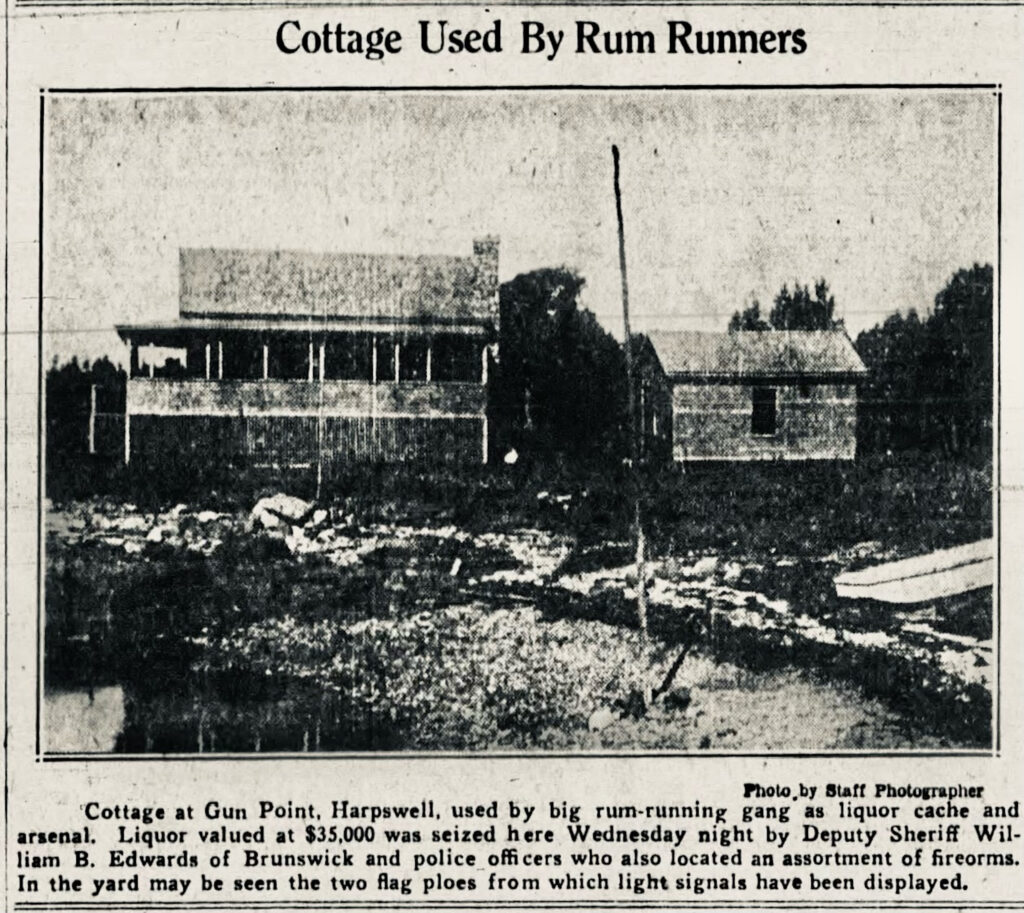
The alcohol was destined for bootleggers at a Harpswell’s Gun Point cottage. In the pitch-black night, lights fastened to two flag poles acted as a beacon to welcome the whiskey peddlers.
This was one of many risky “rum-running” escapades in Harpswell during Prohibition, as well to hundreds of coves along the Maine Coast.
Smugglers raked in big bucks. Thirsty customers quenched their thirst. But not all the gambits were successful.
The Gun Point bootleggers’ cache was seized by law enforcement, including booze worth $35,000 – $646,000 today – along with a rifle and silencer, a .38-caliber revolver and a vest pocket .45 caliber revolver, according to a 1929 Portland Press Herald story. George B. Alberts, who said he was from Calais, “was arrested in connection with the seizure, the biggest in this section of the state for many years.”
The newspaper ran a grainy black and white photo of the cottage, which Harpswell native and historian Jerry York posted on Facebook’s “Harpswell Yesterdays.”
Another newspaper story, written a month after the 1929 Gun Point raid, also was posted by York on the web site.
“Four men believed to be leaders in a big rum ring operating in Maine were arrested and rye whisky valued at $20,000 was seized at 2 o’clock this morning when a posse of Brunswick officers, consisting of Deputy Sheriff William B. Edwards and Officers Charles Alexander, J. P. A. Fournier, Alexis Fournier and Roland Alexander, built a barricade of boulders across the Harpswell Neck highway, just south of the picturesque pond at Skolfield, and confiscated two automobiles.”
More intrigue followed.
A truck sped toward the South Harpswell make-shift barricade. After seeing the cops, the driver jumped out of the vehicle and ran into the woods. The truck was in neutral and began rolling backward down the hill. While deputies were trying to stop it, the driver got away. The truck wound up in a ditch. On the driver’s seat was a .32 caliber rifle.
Meanwhile, a Chevrolet approached the boulders, resulting in the arrest of four men. One was from South Portland and the others were from Massachusetts. Seized was $20,000 worth of whiskey. As the arrested men were headed to jail in the darkness, they were tearing up notebooks, telegrams and letters later linked to rum-running.
“When the truck was unloaded it was found to contain at least 125 cases of choice rye whisky,” according to the newspaper story. “Later the officers returned to Harpswell and on the beach just south of the steamboat wharf at South Harpswell found the wheel marks of the truck and other evidence to show that the liquor was brought ashore and loaded at that point.”
For years, getting a legal drink in Maine was not easy. In 1851, Maine was the first state to pass legislation, known as the Maine Law, banning the manufacture and sale of liquor. Portland Mayor Neal Dow, a tee-totaler and co-founder of the Maine Temperance Society, championed the bill.
After learning that Dow had $1,600 worth of legal “medicinal and mechanical alcohol,” stored in a City Hall vault four years later, “as many as 3,000 people, mostly Irish, started throwing rocks” at the building that June, according to the New England Historical Society website. “Dow called out the militia and ordered them to shoot. During the melee, John Robbins, a 22-year-old sailor from Deer Isle, broke a hole in the door of the liquor vault and unlocked it. Instantly a volley of fire killed him.
“Even as the crowd dispersed, the militia continued to fire. Seven more people were injured. Tragically, Robbins was to have been married the next day.”
The so-called 1855 Portland Rum Riot ended Dow’s career and he “never again held public office, despite running for governor and for the presidency of the United States.”
While the Maine Law was repealed 1856, a booze ban was written into the state constitution in 1885. In 1920, the 18th Amendment to the U.S. Constitution banned the sale, use, production and transport of alcoholic beverages nationwide. The 21st Amendment repealed the ban in 1933; the only amendment to the Constitution ever repealed.
The decades-long alcohol restriction in Maine made smuggling all the more popular, including off Harpswell’s shores.
Tales of rum-running here have been passed down from generation to generation. Some are true. Others likely have more than a kernel of truth.
Folks, like Kay Fulker, noted in a Facebook post, “Years ago there was a nice little shed over a fresh water well on the western shore of Abner’s Point, down a way from the Chase’s cottage. We heard that it had been a bootlegger’s stop-off during prohibition but we never knew for sure any details about it.
“It would be great to know if anyone else knew of this spot,” she later added. “We always felt daring to risk a drink from that cup!”
Michael Henning told a reporter his mother met an old timer who ran “a lot of” booze out to Edna St. Vincent Millay’s Ragged Island.
Sam Alexander, who traces his Harpswell family roots to 1719, said “several people in my father’s generation talked about it.”
It was common knowledge, he said, that during Prohibition a rum-running ship would show up off shore, but stay in international waters in what was known as Rum Row. The three-mile limit was the initial boundary of U.S. jurisdiction.
“Speed boats usually at night would come with their hard cider, so to speak,” Alexander recounted. “It was whisky made from cane sugar and most came from Cuba and those islands.” Other alcohol was illegally ferried from Canada along the Maine coast and delivered by bootleggers.
Steve Johnson is another long-time Harpswell resident. He heard stories about boot-legging from his family.
“My father told me that when he came home one night, he met a guy who wanted to land rum in front of our house on Lowell’s Cove. He told the guy my grandfather didn’t drink so it would not be a good idea.”
Harpswell native and history guru Dave Hackett remembers hearing stories as a kid about a house in North Harpswell called the “chicken coop.”
“I understood there were never any chickens in there. It may have been a rum-runner place or it may not be. I heard it was about rum-running.”
Intervale Road, north of Potts Point, also was a smuggler’s paradise. In the 1920s there were no more than one or two garages on the yet-named dirt road. Hooch would be dropped off by a small boat at low tide at the end of the road and carted by wheelbarrow up the hill to a garage where it was stored for later delivery. Or so the story goes.
There no longer may be rum-running off our coast. Illicit drugs? Now that’s another matter.
November 2025