The Battle of Cundy’s Harbor
by Heather Logan and David Perrier
As Harpswell begins its celebration and looks back on the community, Cundy’s Harbor Library also looked through its collection of historical documents with an eye to the 1770s. An adventure that caught our attention was that of Nathaniel Purinton.
The Purinton family, some of which added an extra r (Purrinton) or a g (Purington), attribute their roots to Humphrey Purrinton of Kittery. Nathaniel moved to Great Island in 1736 with his bride, Priscilla Woodbury of Falmouth. Together they started a farm and built the first grist mill. The mill was run by water from the cove by his farm. Ever an entrepreneur, Nathaniel became part owner of mills in Topsham. Purinton served as selectman from 1766 through 1787. During the Revolutionary War he served in the Second Cumberland County Regiment.
This is where he and a company of 30 men defeated the British ship, the Picaroon. His company included Isacc, Elisha, and John Snow as well as Henry Merritt, Humphrey and Stephen Purinton, along with Abraham Toothaker. Was it for love of country? Was it for the revolution? No. Simply put these men were defending their homes and community. The Picaroon had come into Cundy’s Harbor to rob both farmers and fishermen.
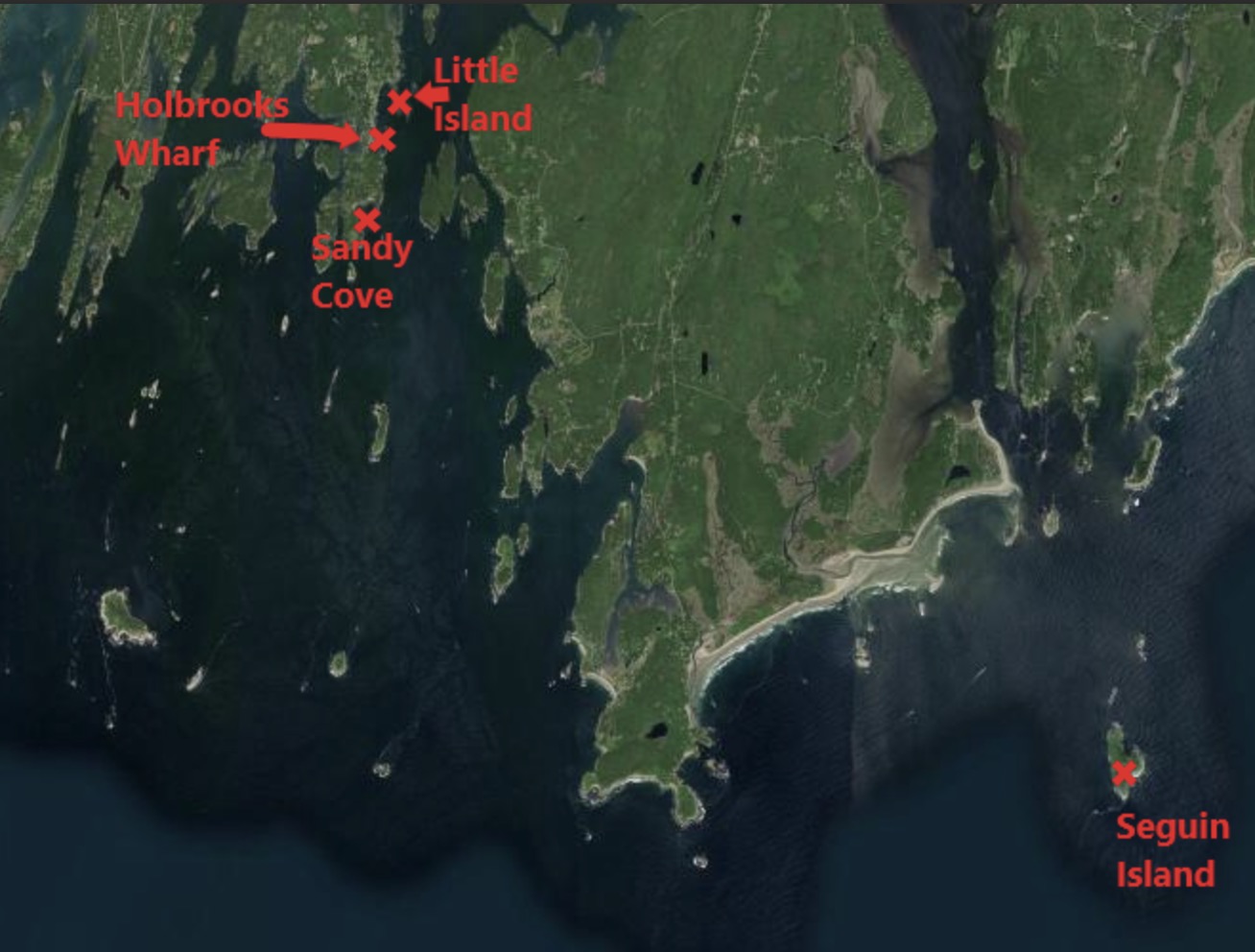
But when the company assembled in the harbor they found the Picaroon had set sail to plunder a coaster from Thomaston laden with corkwood and lime. The crew boarded John Snow’s boat “Shavingmill” as it had both sails and oars, They gave chase to Small Point where they exchanged the smaller vessel for the schooner “America”.
Seguin Light was where the scrimmage began. The British had captured the Thomaston coaster and decided to move two brass swivel cannons from the Picaroon. Meanwhile the America with the Cundy’s Harbor company aboard quickly overtook them. Purinton ordered his men to stay out of sight and only fire upon orders. When the America was within 3 miles, the men rose and fired upon the captured coaster. Josiah Totman struck the vessel on the quarter and made the ships fast. By 3 PM the boat was boarded, finding one crew member dead, one shot in the knee and seven begging for mercy down below.
The dead man who was called Shepard, hailed from Halifax, and thus the crew brought him back to Cundy’s Harbor where they buried him at Shepard’s Point. Today this is known as Little Island and can be seen from the library. A private home sits atop this point and is a favorite perch for eagles and osprey.
The prisoners, being Tories, were sent to Portland under guard. The two brass swivel cannons remained in Purinton’s possession. One was given to Parsonsfield Academy in 1837. The other stayed in Cundy’s Harbor and burst during the 4th of July celebration of 1889.
Purinton lived in Cundy’s Harbor by Sandy Cove. His two story house and barn was located next to Trufant’s Wharf (Holbrooks). In 1850 the house burned but was rebuilt as the barn was unharmed. By 1900 both had been destroyed.
Colonel Nathaniel Purinton is buried in Cranberry Horn Cemetery beside his wife Priscilla. He was 52 in 1788. Priscilla was 77 when she was placed beside him in 1806. His son Stephen, having “found religion,” helped form the First Free Will Baptist Church, where he owned Pews 19 and 32. Stephen and his wife, Mary Merrill inherited the 100 plus acre farm from Nathaniel. They too are buried in Cranberry Horn Cemetery.
As you celebrate the 250 years plus of Harpswell history, be sure to visit the harbor, the cemetery, and as you pass the Baptist Church thank the women of the Sebascodegan Garden Club who maintained and restored the building before turning over to the Harpswell Historical Society. (March 2026)
Some of the above Information was obtained from an article by William Purinton published by the Coastal Publishing Co. September 24, 1968.
Read the “The capture of the British ship Picaroon at Cundy’s Harbor” article here.
Read the “Author Tells Adventures of Two Early Harpswell Settlers” article here.
Read “Some Stories in honor of Harpswell’s 250th year” here.