1928 Film about Rum-Running on the Maine Coast
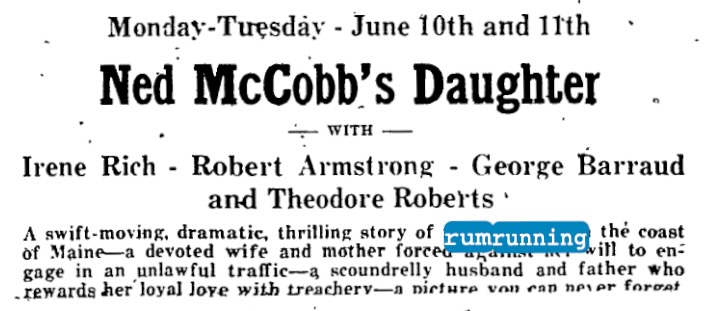
“Ned McCobb’s Daughter” is a distinct film from the transitional era of Hollywood (late silent/early sound), released by Pathé Exchange in late 1928 and circulating through 1929. It is a melodrama that blends domestic struggles with the high-stakes tension of Prohibition-era crime.
Here are the details regarding the film, its plot, and its production context:
The Basics
- Release Date: December 2, 1928
- Director: William J. Cowen
- Studio: Pathé Exchange
- Source Material: Based on the successful 1926 Broadway play by Pulitzer Prize-winner Sidney Howard.
The Plot: Rumrunning in Maine
The story is set in the rugged, coastal atmosphere of Kennebec, Maine. It centers on **Carrie McCobb** (played by Irene Rich), a stoic and hardworking New England woman who manages a failing ferry and an inn (or spa) while trying to maintain the dignity of the McCobb family name.
Her life is complicated by two men:
- George Callahan (George Barraud), her weak and corrupt husband who has been skimming money.
- “Babe” Callahan (played by Robert Armstrong), a charismatic but dangerous bootlegger from the city.
The Conflict:
After the death of the patriarch, Captain Ned McCobb, Carrie discovers that her husband has stolen heavily from the family business. To make matters worse, her husband invites his brother, the bootlegger “Babe,” to hide out at their establishment.
Babe realizes the McCobb property on the coast is the perfect location for smuggling alcohol (rumrunning). He attempts to coerce Carrie into allowing him to use her barn as a base of operations. The dramatic tension revolves around Carrie’s “Yankee shrewdness” and moral fortitude as she attempts to outwit the criminal, save her children, and secure her financial future without compromising her integrity.
The Cast
- Irene Rich as Carrie: Rich was a major star of the silent era, known for playing virtuous, suffering, yet strong maternal figures.
- Robert Armstrong as “Babe” Callahan: Armstrong is best known today for playing Carl Denham in *King Kong* (1933). In this film, he plays the heavy—a cocky bootlegger who underestimates the country woman.
- Carole Lombard as Jenny: A notable point of interest for film historians is the appearance of a young Carole Lombard in a supporting role (a waitress/flirtatious girl), shortly before she became a major screwball comedy star.
Production Context (The Sound Transition)
This movie was released during the awkward transition from silent films to “talkies.”
- It was originally produced as a “Silent” film.
- However, to compete in the changing market, it was released with an RCA Photophone soundtrack. This included a synchronized musical score and sound effects, but it was not a full “talkie” with constant dialogue.
Critical Reception
At the time, the film was praised for the performance of Irene Rich. The adaptation of Sidney Howard’s play was considered successful in translating the stage dialect and distinct “Maine atmosphere” to the visual medium. It is often cited as a feminist narrative for its time, as the heroine triumphs not through romance, but through business acumen and protective motherly instinct.
Source: From a search on Google Gemini 3 Pro on 11/30/25. Facts not verified.