The Captain Johnson H. Stover Jr.’s Home in South Harpswell
by William McLin and Samuel McKeon
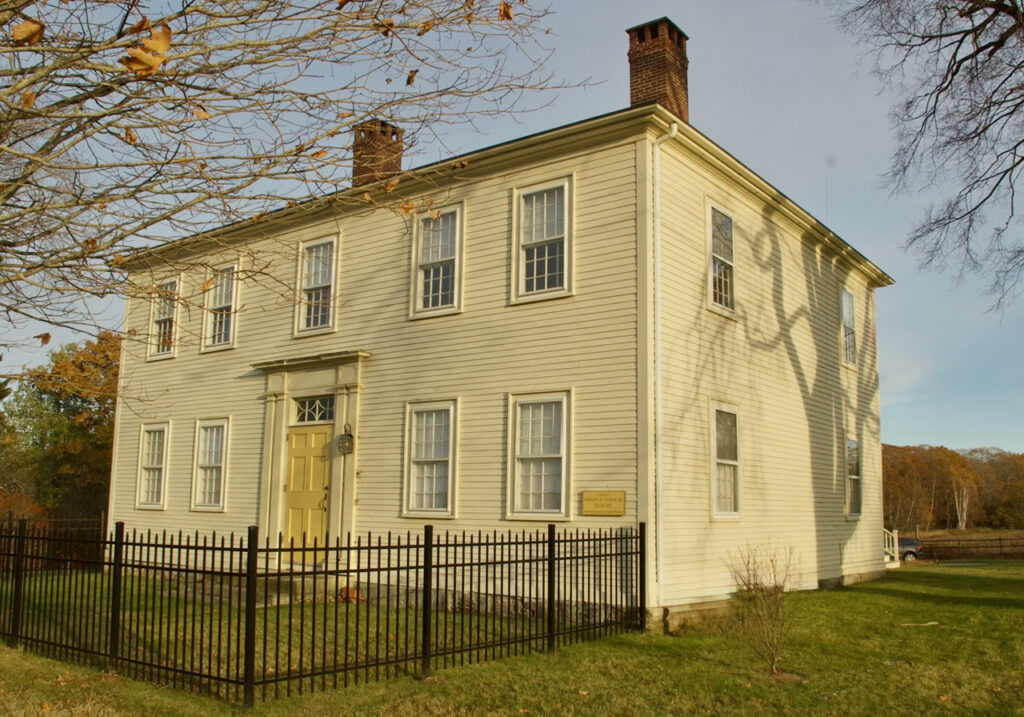
The Capt. Johnson H. Stover, Jr. House is a nationally significant example of Federal style architecture, associated with one of the founding families of Harpswell. At the time of its construction, it would have been one of the largest and finest homes on Harpswell Neck. The house is a two-story hip roofed Federal style structure with a five-bay façade facing north. It is located near the tip of the Harpswell Neck peninsula, between Casco Bay and Harpswell Sound. Built as a shipyard owners’ residence, it is still surrounded by open fields and retains integrity of setting, feeling, and association.
Documentation indicates the house was built by mariner and farmer Capt. Johnson H. Stover, Jr. (1772-1856) shortly after he purchased the property in 1806. This date corresponds with the Federal architectural style of the house. The house features well-detailed Federal style interior finishes. One of the most notable exterior features is the front door surround with paired pilasters and a paneled entablature framing a wide six-panel door and transom with a Federal style muntin pattern. The simple treatment of relatively narrow corner boards and restrained cornice below the hipped roof reflect the simplified Federal style detailing often found in rural Maine communities. This differs from the more elaborate facades that can be found on Federal style houses in more urban communities like Portland or Wiscasset. Two original high chimneys serve eight fireplaces.
Some interior trim details are similar to documented work by Brunswick area master-builder and architect Samuel Melcher III, particularly the reeded wainscot cap and unusual newel post on the front stair. An identical newel post can be found in the Holden-Frost House in Topsham and is documented as Melcher’s work. Unfortunately, the Melcher account books located at the George J. Mitchell Special Collections and Archives at the Bowdoin College Library are missing for the years 1806-1811. Some of the work in the house closely resembles work by Melcher, the recognized finest master craftsman in the area during the period of construction. A number of carpenters who trained under Melcher worked on their own as well, so without documentary evidence attributions are not possible. Published histories of Harpswell from the second half of the 20th century attribute construction of the house to Johnson Stover, Jr.’s son, Abijah, who was born in 1823. This is at odds with the style of the house and is not borne out by deed research, which shows that the house passed from Capt. Johnson Stover, Jr. to his son, Johnson Stover III in 1857 and was sold by Johnson Stover III to his brother, Abijah.
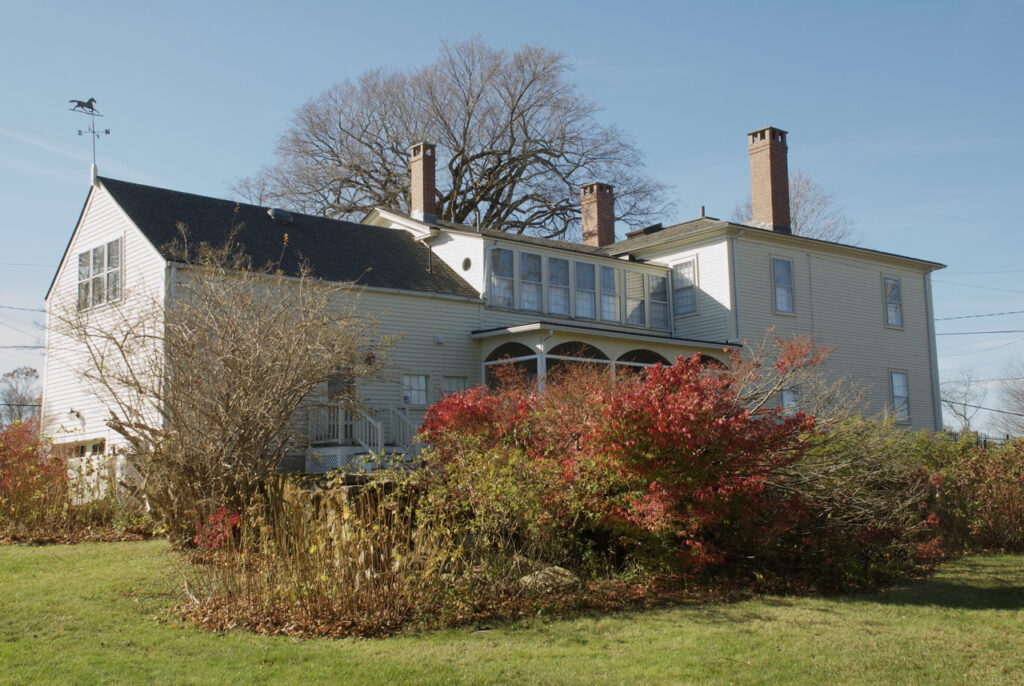
Several interior spaces were updated in the Greek Revival style, likely when it passed first to Johnson Stover III in 1857 or his brother Abijah in 1859. This is also when the kitchen was moved into the ell on the rear of the house. Decorative grained and marbleized paint finishes that remain partially exposed in two rooms may also have been added at this time. Decorative painting is likely present in other areas under later coats of paint. Like many Colonial and Federal style houses on the Maine coast, it passed into the hands of wealthy summer visitors in the later 19th century and was used as a summer home. Minor alterations were undertaken in several rooms and a back porch added in the Colonial Revival style in the early 20th century. The house retains integrity of location, design, setting, materials, workmanship, feeling, and association to the c. 1806 to c. 1860 period of significance.
The Captain Johnson H. Stover Jr. House, upon the recommendation of the Maine Historic Preservation Commission, was entered into the National Register of Historic Places in June 2018 with the following notation:
“Be it further certified that by inclusion in the National Register the Captain Johnson H Stover Jr. house is recognized as a part of the Historical and Cultural Heritage of our nation and should be preserved as a living part of our community life and development in order to give a sense of orientation to the American people.”